Light Pollution
In astronomy, observations of the night sky are crucial. Even a bright phone or computer screen can keep you from seeing the stars. That's one reason this page uses an odd set of colors (orange on black): to help use this page while you're viewing the night sky.
In astronomy, all we can do is collect the incoming starlight. We cannot go to a star to chemically test for its composition. We also cannot add or remove objects to see how the interaction changes (as we can in other sciences). Instead, astronomy relies solely on observations for data.
But what happens when the sky is too bright?
If you live in a big city, or happen to notice the sky when you go downtown, it is clear that not everyone has the ability to view the night sky - even when it is clear weather. In some places, artificial lighting is so bright and poorly directed that the sky itself becomes too bright to see the stars! This section is about a danger that is rarely considered when putting up lights - the dangers of light pollution, especially in the forms of glare, clutter, sky glow and light trespass.
Light Pollution Maps
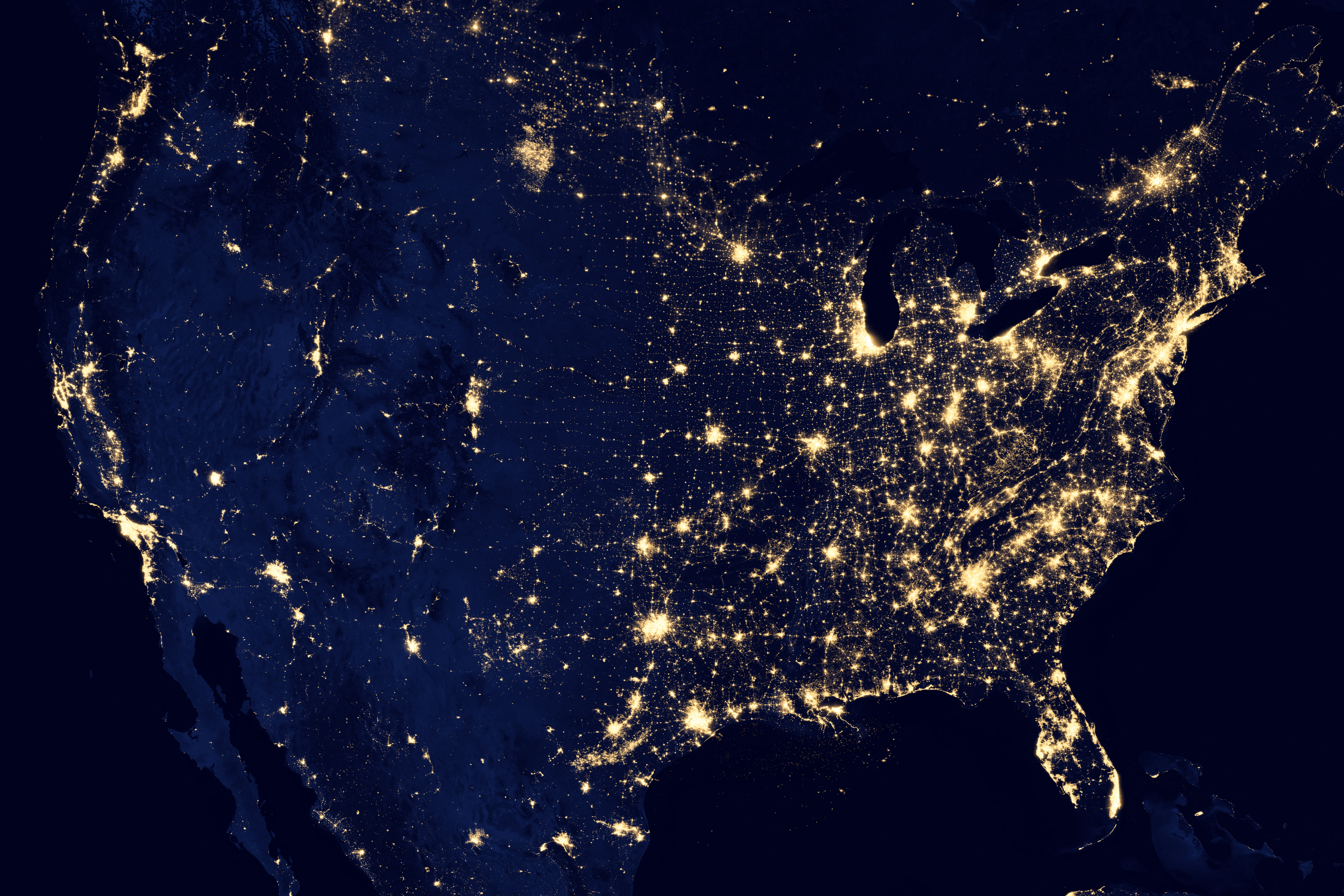
There are several resources on this page to explore how bad the problem of light pollution is getting and how bad it is in your area. The top image at the right is a NASA/NOAA image of the United States, from Space, at night. This image was created using the Suomi NPP satellite with a Visible Infrared Imaging Radiometer Suite. The satellite is the product of the partnership between NASA, NOAA and the Department of Defense. You can read more about this image at this NASA site.
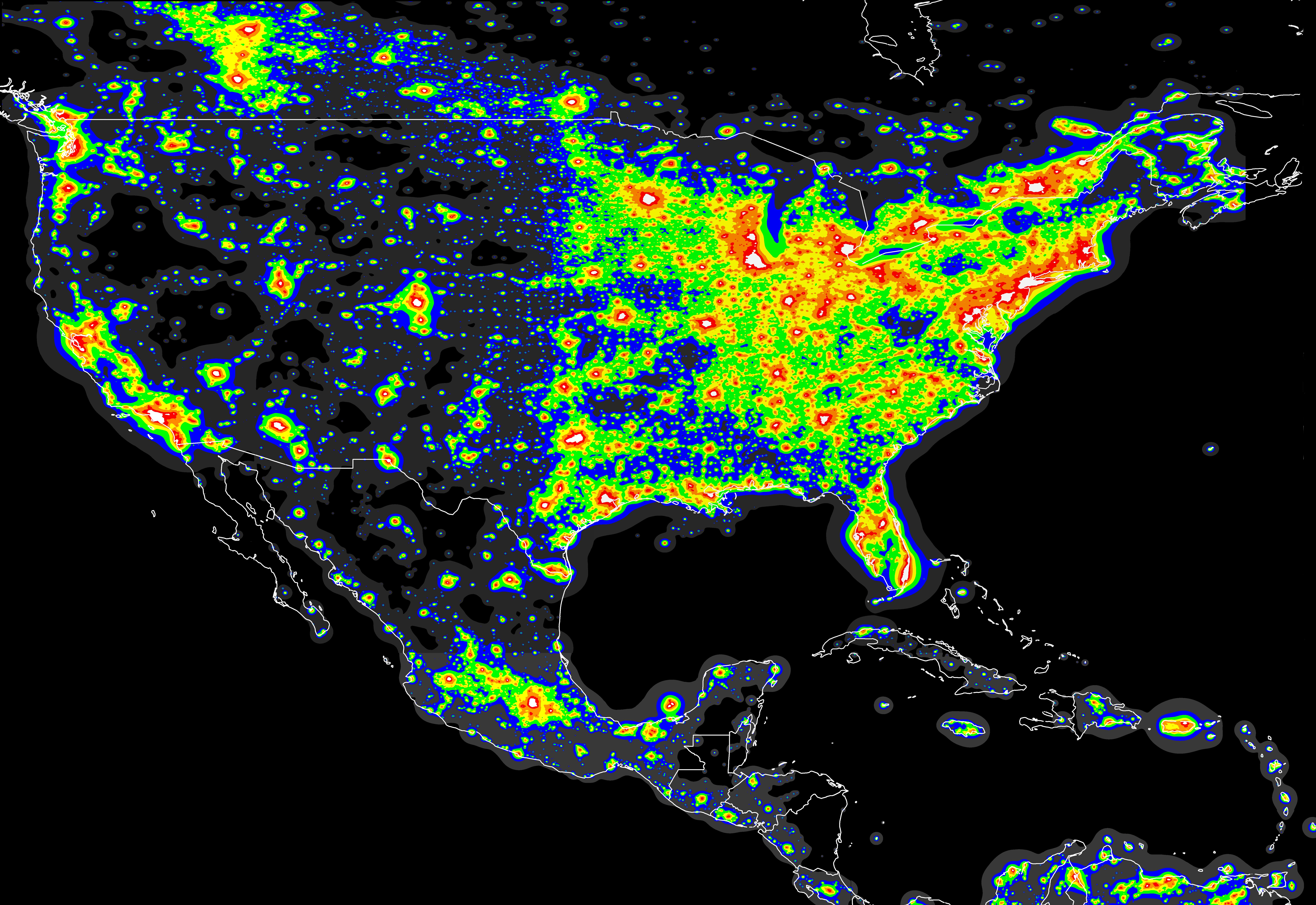
Notice that all of the cities are lit up very brightly, especially Chicago and New York areas. However, this map doesn't really show the extent of the impact of light pollution. In the next image down, we can see how far reaching the effects of light pollution are by observing the sky brightness due to artificial sources.
The colorful image at the right is a linked image from the The New World Atlas of Artificial Night Sky Brightness by Falchi et al., published in 2016. In this image, you can clearly see the impact of sky brightness extending away from the cities to the extent that most of the Eastern US is covered by light pollution!
How can I see the light pollution impact where I live?
The easiest way is to use one of the linked resources below:
- Light Pollution Map with the Latest Data
- Dark Site Finder Map
- Google Maps - No light pollution information, but a helpful resource.
Learn more about Light Pollution and its impacts at The International Dark Sky Association.
Misconceptions
In this section, we want to point out a number of misconceptions about outdoor lighting.
Brighter Lighting Improves Safety - FALSE
It's commonly believed that increased lighting will increase visibility. But this is usually not true. Instead, it all depends on the amount of glare. Consider the following resources:
- Glare from nightime lighting can create visual disability (American Medical Association, 2012)
- Dimming or turning off streetlights has no effect on vehicle accidents (UK, 2015)
- It is unclear whether lighting prevents or enables muggings at ATMs (US Department of Justice, 1997)
Nighttime Lighting Prevents Crime - FALSE
It's commonly believed that light deters crime. However, the opposite could, in fact, be true. Just consider that crime rates are higher in well-lit urban environments than poorly-lit rural environments. If you think this isn't a valid idea, just consider the following resources:
- Lighting does little or nothing to deter crime. (US and UK, 2008)
- Crime is reduced with lower light levels. (Australia, 2003)
- Improved lighting does not prevent crime. (US DoJ, 1997)
- Dimming lights resulted in reduction of crime. (UK, 2015)
- Better street lighting has had little or no effect on crime. (UK, 1991)
- Correlation between brightly lit alleyways and increased crime.(Chicago, 2000)
- Immediate decline in vandalism and graffiti when the security lights were turned off.
Light Pollution is only a Problem for Astronomers - FALSE
It's commonly believed that using bright lights has few negative side effects. However, many studies that make this claim are disregarding a large amount of research:
- Nighttime lighting is linked to sleep disorders, depression, obesity, breast cancer and more. (Chepesiuk, 2009)
- Nighttime lighting is linked to breast cancer, obesity, diabetes, mood disorders, and reproductive problems. (Stevens et al. 2013, American Medical Association)
- Excessive lighting associated with unusually early tree budding. (ffrench-Constant et al. 2016)
- Light pollution is disrupting the nesting activities of sea turtles. (Brei et al. 2016)
- Light pollution is known to have negative effects on Moths and Bats. (McLeish 2021)
- As more of the night sky's visibility is limited by light pollution, we will lose connections to our cultural heritage. (Hamacher et al. 2001)